The “Liquid Ceiling”: Why Enterprise Brands Are Smashing Their Themes
In the lifecycle of every high-growth Shopify merchant, there comes a moment of friction. It’s not a server crash or a checkout failure—Shopify’s infrastructure handles those seamlessly. Instead, it’s a silent, creeping paralysis in the frontend. Marketing wants a dynamic, app-like product page, but the theme architecture says “no.” SEO teams demand specific URL structures for international expansion, but Liquid’s rigid routing fights back.
We call this the “Liquid Ceiling.”
For businesses doing $1M–$10M in GMV, Shopify’s theme ecosystem is a superpower. But for the enterprise—brands scaling to $50M, $100M, and beyond—that same ecosystem often transforms from a launchpad into a cage.
Here is why sophisticated brands are picking up the hammer (or rather, Hydrogen) to break through.
1. The “App Spaghetti” Problem
Liquid themes rely heavily on third-party apps for functionality. Need a wishlist? Install an app. Need a bundle builder? Install another.
On a standard storefront, this creates a tangled web of injected JavaScript. Each app adds its own scripts, tracking pixels, and CSS, often competing for main-thread resources. The result?
- Degraded Performance: Your “fast” theme slows down with every feature you add. Data shows that for every 3 apps installed, average page load time increases by ~6-8% due to unoptimized script injection.
- Vendor Lock-in: You don’t own the code; you rent it. If an app developer changes a feature or raises prices, your hands are tied.
- UI Inconsistency: “Frankenstein” UX where the wishlist button doesn’t match the cart drawer because they come from different vendors.
The “Technical Debt Interest Rate”
Think of your theme like a credit card. Every time you install an app to solve a short-term problem, you are borrowing against your site’s long-term performance.
- Liquid Interest Rate: High. You pay “interest” on every page load (latency) and every code deploy (conflicts).
- Hydrogen Interest Rate: Zero to Low. You build it once, you own the code. You pay down the principal immediately.
Visual Insight:
[!TIP] See it in action:
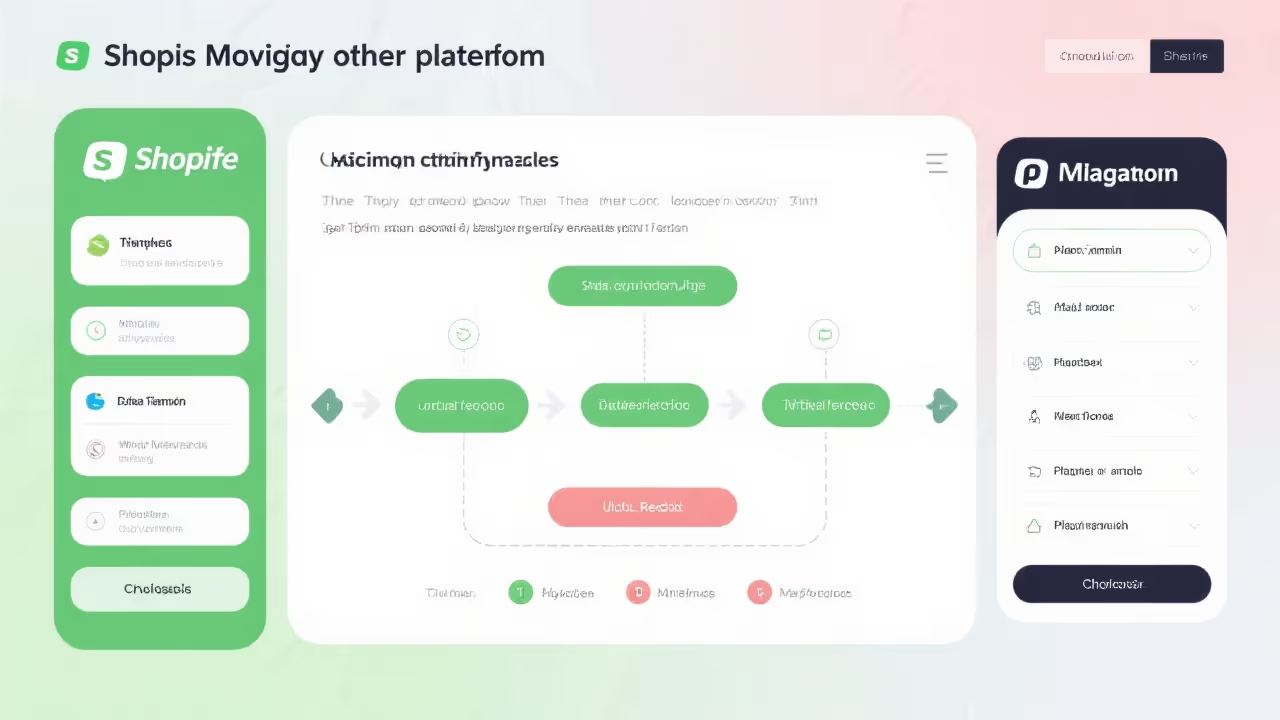
SHOPIFY CORE🌐Hydrogen (Web)📱iOS App💳Instore POS🪞Smart MirrorNotice how the frontend (Web/Mobile) is decoupled from the backend logic? This separation allows you to swap out the “wishlist engine” without breaking the “wishlist UI.”
The Hydrogen Solution: With Hydrogen, you don’t “install” frontend apps—you build features. You own the code. You own the wishlist logic, the bundle builder UI, and the pixel implementation. You stop renting your UX and start owning your intellectual property.
[!NOTE] What about Checkout? Going headless doesn’t mean building a custom checkout (which is risky). Hydrogen integrates seamlessly with Shopify Checkout Extensibility. You get the freedom of a custom frontend while retaining the world’s highest-converting, secure checkout.
2. Breaking the URL Straightjacket
Liquid has arguably the most rigid routing structure in modern commerce.
yourstore.com/products/blue-shirt
yourstore.com/collections/summer-sale
yourstore.com/pages/about-us
For an enterprise retailer, this is stifling.
- SEO Limitations: You can’t create
yourstore.com/summer-sale/blue-shirtwithout complex workarounds that often hurt SEO canonicals. - Internationalization: True sub-folder localization often requires sophisticated proxying or strictly adhering to Shopify Markets’ default paths.
The Hydrogen Solution:
Hydrogen is built on Remix, which gives you complete control over routing. Want /shop/men/jackets/winter/north-face? Done. Want to serve entirely different content structures for a B2B portal on a subdomain? Easy. You map the URL to the experience, not the other way around.
3. When “No-Code” Becomes “Roadblock”
The “No-Code” promise of the Theme Editor (JSON templates) is great for giving marketing teams agility—until it isn’t.
At an enterprise scale, marketing campaigns are not just “hero banners.” They are immersive, interactive experiences. They involve 3D product configurations, rich storytelling that blends content and commerce, and dynamic personalization based on real-time user data.
Trying to shoehorn these experiences into a Liquid section schema is like trying to build a skyscraper with LEGO blocks. You can do it, but it’s fragile, hard to maintain, and scares your engineers.
The Hydrogen Solution: Hydrogen utilizes React Server Components. This means you can build complex, data-driven components that render on the server (for speed) but hydrate on the client (for interactivity). Your engineering team isn’t fighting the platform; they are using standard, modern web technologies to build exactly what the creative team designed.
Conclusion: The Shift from “Merchant” to “Tech Company”
Moving to Hydrogen is not just a tech stack swap; it’s a mindset shift. You stop being a merchant that uses Shopify and start being a commerce technology company that builds on Shopify.
For the enterprise, that distinction is the difference between surviving the next five years and defining them.